

Maternity claims require careful coordination between prenatal care, labor management, delivery, postpartum services and payer-specific billing requirements. When an OB/GYN practice incorrectly reports global maternity services, fails to document a cesarean delivery or selects the wrong VBAC code, the consequences can include denied claims, payment delays, additional documentation requests and payer recoupments.
These challenges are becoming particularly important as OB/GYN practices prepare for the January 1, 2027 CPT maternity-care restructuring. Traditional global maternity codes are being replaced by separate reporting for antepartum care, labor management, delivery and postpartum services.
A comprehensive OB/GYN billing audit helps practice owners identify unbundled services, documentation deficiencies, incorrect delivery coding and reimbursement discrepancies before they become recurring compliance problems. Reviewing these areas now also helps billing teams prepare for the new 2027 reporting requirements.
Why Do Maternity Claims Create Payer Audit Risks?
Unlike a routine office visit, maternity care may extend over several months and involve multiple physicians, hospitals, specialists and billing entities. A single pregnancy can generate numerous claims, making it difficult to maintain consistent documentation and accurate charge capture.
Payer reviews may focus on whether:
- Routine prenatal visits were billed separately despite being included in a global maternity package.
- The practice provided all components required for the global claim.
- Cesarean delivery documentation supports the services reported.
- VBAC claims reflect the actual delivery outcome.
- Separately reported medical services meet documentation and medical necessity requirements.
- Different providers submitted overlapping claims for the same maternity services.
- Insurance coverage and authorization were valid on the dates of service.
The risk is not limited to incorrect CPT codes. Incomplete medical records, inconsistent provider information, duplicate charges and payer-specific billing restrictions can also affect claim reimbursement.
For practice owners, these problems can create additional administrative costs, delayed collections and potential repayment obligations. Because global maternity arrangements often involve months of care before reimbursement, delayed global maternity billing can also create cash-flow challenges for OB/GYN practices.
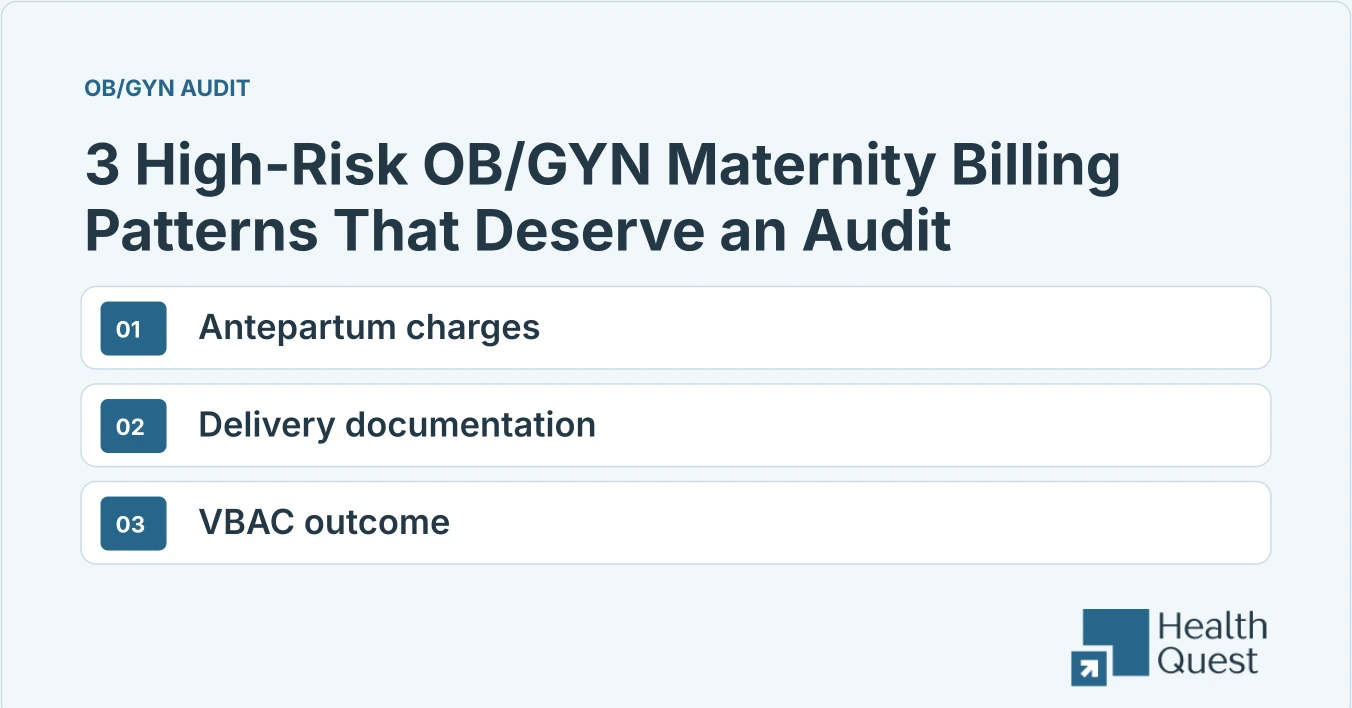
3 High-Risk OB/GYN Maternity Billing Patterns That Deserve an Audit
1. Unbundling Routine Antepartum Visits During Global Maternity Billing
One common audit concern is reporting routine prenatal visits separately when the practice also submits a complete global maternity claim.
For 2026, CPT codes 59400, 59510, 59610 and 59618 represent global obstetric care arrangements that include specified antepartum, delivery and postpartum services.
Example of a potential billing error:
An OB/GYN practice provides routine prenatal care, performs a vaginal delivery and completes the associated postpartum care. The billing team submits CPT 59400 along with separate E/M charges for all routine prenatal visits.
If those visits are already included in the global package, billing them again can create duplicate reimbursement and payer recoupment exposure.
When can maternity services be billed separately?
Separate reporting may be appropriate when:
- The patient transfers before delivery and the original practice provides only antepartum care.
- The practice provides delivery-only or postpartum-only services under the applicable billing arrangement.
- A separately identifiable, medically necessary service falls outside the global package.
- The payer requires individual encounter or trimester-based reporting.
For example, 59425 represents antepartum care involving four to six visits, while 59426 represents seven or more visits under the 2026 CPT structure. These are not additional charges to automatically submit alongside a complete global package.
ACOG also explains that third-party payers may have different requirements for reporting obstetric services. Practices should therefore verify the individual payer’s global maternity policy. For a closer look at reimbursement problems, see common causes of global maternity code denials in 2026 and how to prevent them.
What should an auditor review?
- Prenatal visit dates and total visit counts.
- Global claim submission and delivery documentation.
- Whether all components were provided by the same practice or group.
- Separately billed E/M encounters.
- Transfer-of-care records.
- Payer rules for additional pregnancy-related services.
2. Cesarean Delivery Documentation and Medical Necessity Gaps
Cesarean claims deserve careful review because the operative documentation must accurately reflect the procedure performed and the circumstances surrounding the delivery.
A claim may face additional scrutiny when the medical record does not clearly support the reported procedure or explain the clinical circumstances.
Example:
An OB/GYN practice reports a global cesarean maternity claim using CPT 59510. However, the operative report does not adequately describe the cesarean procedure, and supporting clinical documentation is incomplete.
A payer requesting medical records may question whether the claim is supported by the documentation. Depending on the applicable policy and findings, the practice could face a denial, payment reduction or recoupment request.
Importantly, an undocumented cesarean indication does not automatically mean a payer should replace a cesarean code with a vaginal delivery code. The code must reflect the actual service performed. Medical necessity and reimbursement are evaluated using the clinical documentation and applicable payer requirements.
Documentation areas to review include:
- Clinical indication for cesarean delivery.
- Maternal and fetal assessment supporting the delivery decision.
- Relevant fetal heart rate monitoring when applicable.
- Induction or labor progression when relevant.
- Trial of labor after previous cesarean (TOLAC) documentation.
- Operative report and procedure details.
- Physician assessment and decision-making.
- Prior authorization or notification records when required.
For cesarean deliveries, practices should ensure that the operative report, delivery record and submitted claim tell a consistent clinical story.
This is especially important for high-risk pregnancies, failed inductions, fetal complications and repeat cesarean procedures.
3. VBAC Coding Errors and Incorrect Delivery Outcomes
Vaginal birth after cesarean (VBAC) creates another important audit area because the appropriate 2026 code depends on the actual care provided and delivery outcome.
For 2026, relevant global maternity codes include:
| CPT code | 2026 description |
|---|---|
| 59610 | Global routine obstetric care, including vaginal delivery, after previous cesarean |
| 59618 | Global routine obstetric care, including cesarean delivery following attempted vaginal delivery after previous cesarean |
| 59612 | Vaginal delivery only after previous cesarean |
| 59620 | Cesarean delivery only following attempted vaginal delivery after previous cesarean |
For more OB/GYN coding guidance, including the 2026 code set and upcoming maternity reporting changes, review OB/GYN CPT codes for 2026 and the 2027 coding transition.
Example: Successful VBAC
A patient with a previous cesarean undergoes TOLAC and successfully delivers vaginally. If the practice provides the complete global maternity services, CPT 59610 is the relevant 2026 global code.
Example: Unsuccessful VBAC
A patient attempts vaginal delivery after a previous cesarean but ultimately undergoes another cesarean delivery. If the practice provides the complete global maternity services, CPT 59618 is the relevant 2026 global code.
Billing 59610 when the actual outcome is a cesarean following attempted VBAC can create a coding discrepancy.
What documentation should practices maintain?
- Previous cesarean delivery history.
- VBAC counseling and documented management plan.
- Patient-specific TOLAC assessment.
- Labor and delivery records.
- Actual delivery outcome.
- Operative report when a cesarean is performed.
ACOG emphasizes documenting the counseling and management plan for patients considering TOLAC.
Practices must also prepare for the 2027 changes. The AMA specifies that successful VBAC delivery will be reported with CPT 59432. When a patient with a previous cesarean undergoes another cesarean, CPT 59503 applies, even when TOLAC was attempted.
Other Maternity Claim Issues That Can Trigger Payer Reviews
Beyond these three high-risk patterns, an OB/GYN billing audit should examine several additional areas.
| Audit area | Potential billing problem | What to verify |
|---|---|---|
| Transfer of care | Overlapping or incomplete claims | Provider responsibility and visit history |
| Modifier 25 | Unsupported separate E/M charge | Separate service and medical necessity |
| High-risk pregnancy | Additional visits incorrectly reported | Clinical documentation and payer policy |
| Ultrasound | Duplicate or unsupported charges | Medical necessity, interpretation and image documentation |
| Fetal surveillance | Inappropriate separate reporting | Performing and interpreting provider responsibilities |
| Postpartum care | Routine and complication-related services confused | Encounter records and applicable billing rules |
| Multiple providers | Duplicate maternity services | Group affiliation and individual services |
| Eligibility | Claims submitted to outdated coverage | Insurance effective dates and authorization |
These findings should be evaluated individually. Not every additional prenatal visit, complication-related encounter or diagnostic procedure is automatically separately payable.
How CPT 2027 Changes Will Affect OB/GYN Maternity Claims
The American Medical Association has approved a significant restructuring of maternity-care reporting, effective January 1, 2027. For a more detailed explanation of the new reporting structure, review 2027 maternity coding changes OB/GYN practices should watch.
The changes affect 35 CPT codes:
| Code update | Number |
|---|---|
| Deleted codes | 17 |
| New codes | 12 |
| Revised codes | 6 |
The traditional global maternity structure will be replaced by four reporting categories.
1. Antepartum Care: Individual E/M Reporting
Existing antepartum codes 59425 and 59426 will be deleted.
Starting in 2027, prenatal encounters will be reported individually using the appropriate E/M codes based on the services provided, applicable documentation and patient setting.
This makes accurate encounter-level charge capture especially important.
2. New Labor Management Codes
Four new codes will identify labor management services:
| CPT code | Description |
|---|---|
| 59080 | Initial-day straightforward labor management |
| 59081 | Initial-day complex labor management |
| 59082 | Subsequent-day straightforward labor management |
| 59083 | Subsequent-day complex labor management |
Labor management codes are reported once per calendar date under the applicable CPT requirements.
Straightforward management requires that all specified criteria are met, including singleton vertex presentation, routine maternal and fetal monitoring, stable medical conditions and no previous cesarean. Cases that do not meet these criteria are classified as complex under the CPT guidelines.
A planned or scheduled cesarean without labor management does not qualify for a labor management code.
3. Separate Vaginal and Cesarean Delivery Codes
The 2027 structure introduces new delivery codes:
| CPT code | Description |
|---|---|
| 59431 | Vaginal delivery, with or without episiotomy |
| 59432 | Vaginal delivery after previous cesarean |
| 59502 | Primary cesarean delivery |
| 59503 | Repeat cesarean delivery |
The distinction between primary and repeat cesarean coding is important.
For example, a patient with a previous cesarean who attempts TOLAC but ultimately requires another cesarean is reported using 59503. A patient with only previous vaginal deliveries who undergoes a cesarean is reported using 59502.
Additional codes include 59433 and 59434 for third- and fourth-degree laceration repairs, 59504 for hysterectomy performed at the same encounter as cesarean delivery, and 59623 for uterine tamponade.
Labor management can be reported separately when the applicable requirements are satisfied.
4. Postpartum Care: Separate E/M Reporting
Existing postpartum code 59430 will be deleted.
Starting in 2027, postpartum care will generally be reported using appropriate E/M codes for individual encounters.
One important exception is that routine immediate postpartum care on the same calendar date as delivery is included in the applicable delivery code. Subsequent inpatient and outpatient postpartum services are reported according to the new guidelines.
This requires practices to distinguish the delivery date from later postpartum encounters.
Important CMS Transition Guidance for 2026–2027
CMS issued an enforcement-discretion notice dated October 30, 2026, allowing HIPAA-covered entities temporary flexibility to use 2026 maternity CPT codes during 2027 for qualifying maternity episodes that began in 2026.
Payers and health plans may issue business rules specifying the circumstances and manner in which those codes can be used. The temporary enforcement discretion runs through December 31, 2027.
This is not a blanket extension of 2026 global maternity billing to all new pregnancies beginning in 2027, nor does the notice establish Medicare reimbursement policy.
The AMA also provides specific transition guidance for cases where delivery occurs in 2026 but postpartum services occur in 2027. Appropriate E/M reporting and HCPCS modifier TH may apply to qualifying postpartum services, subject to the transition guidance and payer requirements.
OB/GYN practices should obtain written payer instructions before updating their billing workflows.
How to Prepare Your OB/GYN Practice for a Maternity Billing Audit
Practice owners should establish a repeatable audit process that reviews coding accuracy, clinical documentation and reimbursement.
- Review global maternity claims: Compare submitted claims with the actual antepartum, delivery and postpartum services provided.
- Validate cesarean documentation: Confirm that operative reports and supporting clinical records are complete and consistent with the reported procedure.
- Check VBAC coding: Verify prior cesarean history, counseling, TOLAC documentation and final delivery outcome.
- Verify payer requirements: Review contractual policies, authorization rules, transfer-of-care requirements and claim submission instructions. Practices serving Texas Medicaid patients can also review OB/GYN billing underpayments and 2027 maternity coding issues in Texas.
- Analyze denials and underpayments: Review remittance advice to identify recurring coding discrepancies, missing documentation and unexplained payment adjustments. Persistent unpaid claims can also contribute to OB/GYN accounts receivable aging beyond 90 days.
- Update billing systems: Test 2027 CPT code changes, EHR charge capture, clearinghouse edits and payer-specific claim configurations.
- Document corrective actions: Record audit findings, responsible staff, corrections and follow-up review dates.
OB/GYN Maternity Claims Audit Checklist
Use this checklist as part of a monthly internal review:
| Audit checkpoint | Verification |
|---|---|
| Global maternity billing | Appropriate package or component billing |
| Antepartum services | Correct encounter count and documentation |
| Cesarean delivery | Operative report and clinical support |
| VBAC | Prior cesarean and actual delivery outcome |
| Transfer of care | Accurate service and provider history |
| Modifiers | Appropriate use and supporting records |
| Ultrasound | Medical necessity and interpretation |
| Postpartum services | Correct dates and encounter reporting |
| Eligibility | Active coverage and required authorization |
| Payment reconciliation | Expected versus actual reimbursement |
| Denial management | Root cause and corrective action |
| CPT 2027 transition | Updated codes and payer instructions |
The goal is to identify recurring billing problems before they lead to larger claim corrections or repayment requests.
Protect Your OB/GYN Practice’s Revenue With Health Quest Billing
Focus on patient care while Health Quest Billing helps your practice address maternity coding errors, reduce preventable denials and recover outstanding reimbursements. Partner with Health Quest Billing to strengthen your revenue cycle, improve claim accuracy and keep your practice’s financial performance on track.
Are maternity billing errors affecting your collections? Schedule an appointment with Health Quest Billing to improve claim accuracy and reimbursement.
Frequently asked questions
What are the most common maternity billing audit findings?
Common findings include incorrect global maternity billing, inaccurate prenatal visit counts, transfer-of-care errors, unsupported separately billed E/M services, inappropriate modifier use and incorrect postpartum reporting.
What happens to global maternity codes in 2027?
Seventeen existing maternity CPT codes, including 59400, 59510, 59425 and 59426, are scheduled for deletion effective January 1, 2027. The new structure separates antepartum, labor management, delivery and postpartum services.
Are maternity claims increasing payer audit exposure?
Maternity claims can attract additional payer scrutiny because global billing, transfers of care, separately reported services and delivery documentation create complex reimbursement requirements. However, a reliable national audit rate of 42–58% for OB/GYN maternity claims has not been established by the sources cited here. Practices should evaluate their own denial patterns, payer requests and internal audit findings.
Can OB/GYN practices bill separately for additional prenatal services?
Yes, when a service is independently reportable, medically necessary and supported by documentation under applicable CPT and payer guidelines. Routine services already included in a maternity arrangement should not be billed again as separate services.
How should practices prepare for the 2027 maternity coding transition?
Review the new CPT guidelines, update EHR and billing systems, train providers and billing personnel, test claim workflows and obtain written payer instructions for episodes that span 2026 and 2027.
How should a successful VBAC be coded?
For complete global maternity care in 2026, CPT 59610 applies to routine obstetric care including vaginal delivery after previous cesarean. Beginning January 1, 2027, CPT 59432 reports vaginal delivery after previous cesarean.
How should an unsuccessful VBAC resulting in cesarean delivery be coded?
For complete global maternity care in 2026, CPT 59618 applies to cesarean delivery following attempted vaginal delivery after previous cesarean. Beginning in 2027, CPT 59503 applies to repeat cesarean delivery.
For general informational purposes. Payer requirements, contractual terms, and applicable rules should be verified for the situation involved.
